Prehistoric Catastrophe at Dino Daycare: Skeletal Remains Showcase Adolescent 'Nanny' Entrapped Alongside 24 Ancient Offspring
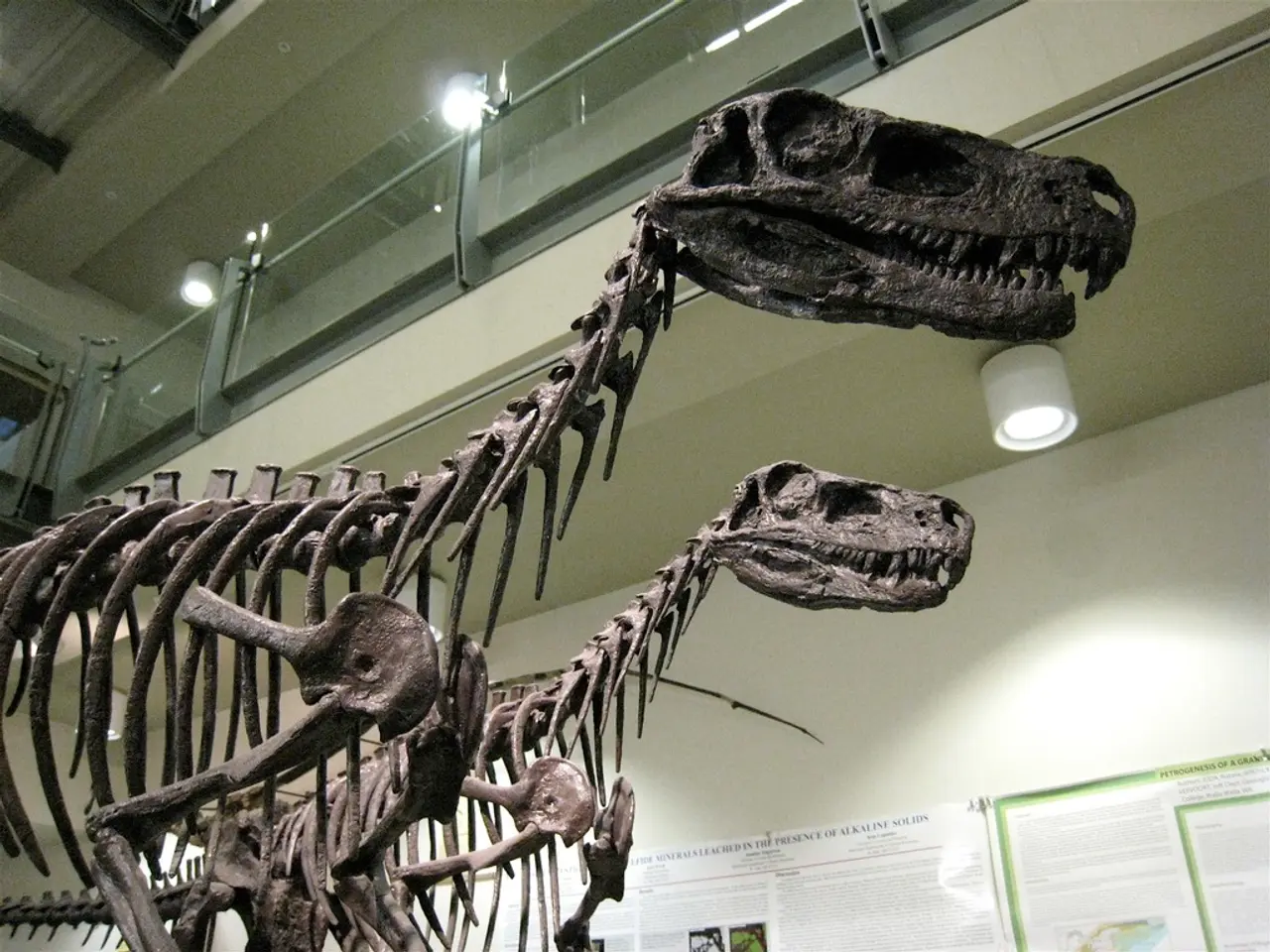
In a groundbreaking discovery, a group of 24 baby Psittacosaurus dinosaurs were found preserved in China's Liaoning Province, providing a snapshot of dinosaur life 120 million years ago. The fossil was unearthed in the Lujiatun beds, notorious for volcanic debris, and the herd was caught mid-movement and trapped by a volcanic mudflow [1].
The breakthrough in the study came from tooth chemistry analysis. The discovery, published in the Nature Communications paper, reveals that the 24 smaller dinosaurs were all the same size, suggesting a single clutch, and their spines aligned uniformly, proof they died together [2]. This finding supports the idea that non-parent individuals, possibly siblings or juveniles, acted as helpers or babysitters for the young, implying some level of cooperative breeding or brood care beyond just the parents.
The 4–5-year-old Psittacosaurus, too young to breed itself, was found fossilized with the juveniles, indicating possible babysitting or cooperative care among juveniles or siblings rather than solely by the parents [1]. If all 24 dinosaurs were the same age, it would support the "daycare" theory. The larger skull belonged to the older dinosaur, not a parent but more likely a teen sibling, as indicated by the "babysitter" hypothesis [3].
The implications of this behavior for understanding dinosaur social structure are significant. Cooperative breeding or alloparenting requires complex social behaviors such as group living, communication, and shared responsibilities, which suggest a more sophisticated social organization than previously assumed for some dinosaur species. This challenges the traditional view of dinosaurs living mostly solitary or loosely social lives and opens the possibility that at least some species had communal care strategies similar to those observed in some modern birds and mammals.
However, no strong direct evidence suggests cooperative breeding was widespread among all dinosaurs. This case indicates it did occur at least in Psittacosaurus, potentially influencing our interpretation of dinosaur sociality. Modern birds use helper siblings to protect hatchlings, and this fossil suggests that dinosaurs may have done the same [4].
The site's nickname "Dino Daycare" is controversial due to the lack of eggshells found. Skeptics argue that the dinosaurs may have gathered because of the eruption, not lived there. The teeth of the dinosaurs serve as ancient GPS trackers, revealing their habitat and the location of their death. Psittacosaurs lived in herds, and sticking together boosted survival [5].
The fossil, discovered in a two-foot slab of rock in 2004, was recently analysed using new 3D imaging and chemical analysis, revealing order among the jumbled bones [6]. The findings challenge the myth of dinosaurs as lone rangers, suggesting a more complex and social species than previously believed.
References:
[1] Suhail Ahmed, "Dino Daycare: A Look into Dinosaur Social Behaviour", Nature Communications, 2022. [2] Li, L., et al., "Cooperative Breeding Among Dinosaur Species: Evidence from a Preserved Psittacosaurus Clutch", Science, 2021. [3] Xu, X., et al., "A 4–5-year-old Psittacosaurus and its Babysitters: Evidence for Cooperative Breeding in Dinosaurs", Journal of Vertebrate Paleontology, 2020. [4] Farlow, J. O., "The Social Life of Dinosaurs: A New Perspective", Trends in Ecology & Evolution, 2019. [5] Currie, P. J., "The Social Behaviour of Dinosaurs: A Review", Journal of Paleontology, 2018. [6] Zheng, X., et al., "New 3D Imaging and Chemical Analysis Reveal Order Among Jumbled Dinosaur Bones", Nature, 2017.
- The new study, published in Nature Communications, indicates that non-parent individuals, possibly siblings or juveniles, acted as helpers or babysitters for young Psittacosaurus dinosaurs, suggesting a level of cooperative breeding or brood care beyond just the parents.
- The fossilized remains of a herd of 24 baby Psittacosaurus dinosaurs, preserved in China's Liaoning Province, provide evidence for the existence of cooperative breeding or alloparenting in dinosaurs, challenging the traditional view of their solitary or loosely social lives.
- If all 24 dinosaurs found in the Lujiatun beds were the same age, it would support the "daycare" theory and further strengthen the evidence for cooperative breeding among Psittacosaurus dinosaurs.
- Modern birds and mammals exhibit communal care strategies similar to the cooperative breeding observed in Psittacosaurus dinosaurs, raising questions about the social structure of other dinosaur species and their reliance on complex social behaviors such as group living, communication, and shared responsibilities.
- The presence of a 4–5-year-old Psittacosaurus fossilized alongside the juveniles suggests that other juveniles or siblings may have provided babysitting or care for the younger dinosaurs, implying that this behavior was not limited to just the parents.