
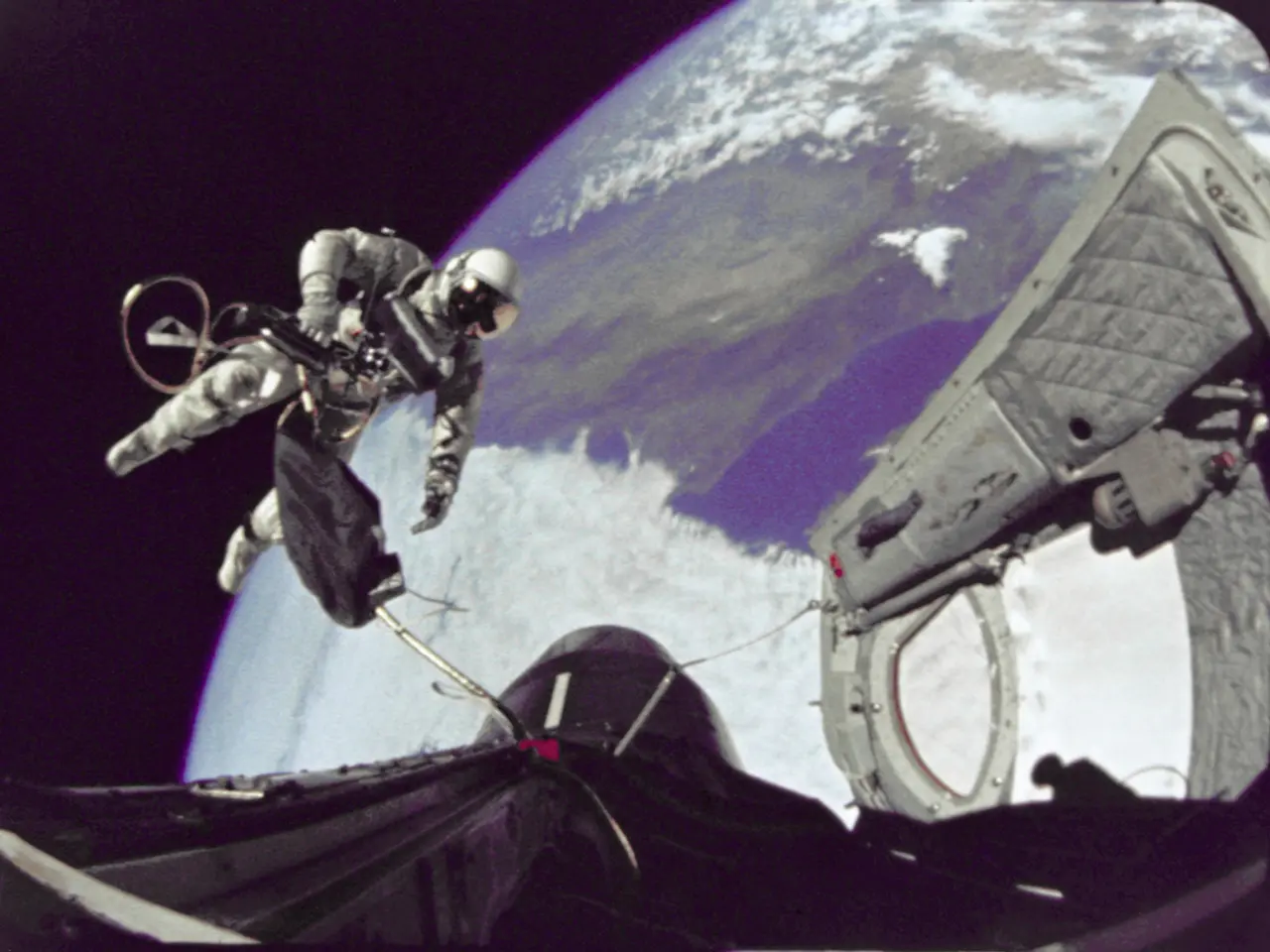
Astronauts from the private Ax-4 mission leave the International Space Station following an unanticipated extended duration (with accompanying video).
The Axiom Mission 4 (Ax-4), a private crewed mission to the International Space Station (ISS), has concluded after a successful 18-day journey. Organized by Axiom Space, the mission was commanded by former NASA astronaut Peggy Whitson and crewed by three first-time astronauts: Shubhanshu "Shux" Shukla from India, Sławosz "Suave" Uznański-Wiśniewski from Poland, and Tibor Kapu from Hungary [1][2][3].
The mission's primary focus was on conducting a record number of experiments and technology demonstrations, with contributions from 31 different nations. This unprecedented level of international participation underscored the mission's global outreach and collaborative ethos [1].
**Research and Science Investigations**
The Ax-4 mission aimed to advance scientific understanding in the microgravity environment. Typical areas of research on such missions include life sciences, materials science, technological demonstrations, Earth and space science, and educational and public outreach [1].
While specific investigations were not detailed, the mission's broad scope and historic national milestones highlight its importance in advancing both science and international cooperation aboard the ISS.
**National Milestones**
The mission was particularly significant for India, Poland, and Hungary, as it marked the first time citizens from these countries lived and worked aboard the ISS [1][3]. Each astronaut's participation included national research objectives, contributing to their countries' growing roles in space exploration and the global scientific community [3].
**Crew Training and Preparation**
The Ax-4 crew underwent extensive pre-mission training, including mastering routine and emergency ISS operations, medical procedures, and media exercises, to ensure mission success and the smooth execution of their scientific agenda [4].
**Outcomes and Impact**
The Ax-4 mission returned impactful scientific data, showcasing the value of international cooperation in space research and inspiring future missions and participation from nations new to human spaceflight [3]. The mission also set a precedent for private and national entities to collaborate on the ISS, paving the way for expanded access to orbital research opportunities.
**Key Points**
| Aspect | Details | |--------------------------|------------------------------------------------------------------------------------------| | Mission Duration | ~18 days (launched June 26, returned July 15, 2025)[1][3] | | Experiments Conducted | >60, from 31 nations[1] | | Research Focus | Microgravity science, technology demonstrations, life & materials science, outreach[1] | | National Milestones | First Indian, Polish, and Hungarian astronauts on ISS[1][3] | | Crew Training | Extensive, including operations, emergencies, media, and international coordination[4] | | Significance | Expanded global access to ISS research; model for international collaboration[1][3] |
**Conclusion**
The Ax-4 mission, under Peggy Whitson’s command, was a landmark in private and international spaceflight, conducting a wide array of scientific investigations and setting new standards for global participation in orbital research [1][3]. While specific experiment details are not provided in the available sources, the mission’s scale, diversity, and historic national milestones highlight its importance in advancing both science and international cooperation aboard the ISS.
- The success of the Axiom Mission 4 (Ax-4) has underscored the potential for technology demonstrations and science experiments in the microgravity environment to yield significant advances when conducted through extensive international collaboration.
- Beyond the immediate results of the Ax-4 mission, the focus on environmental research and monitoring could lead to tangible news headlines about groundbreaking discoveries in space-and-astronomy, emphasizing the importance of scientific exploration to the preservation of our planet.
- The global atmosphere of friendly competition in sports can serve as an inspiration for the spirit of cooperation that the Ax-4 mission exemplified in the realm of science and technology.
- As nations continue to invest in state-of-the-art facilities and cutting-edge research, the outcomes of missions like Ax-4 will have a profound impact on the world, making sports and technology the new frontiers of national pride, as well as contributing to the ongoing advancement of science and the environment.




.)